Protect confidential documents, pitch decks, and private links with a 4-digit PIN code verified on the fly.
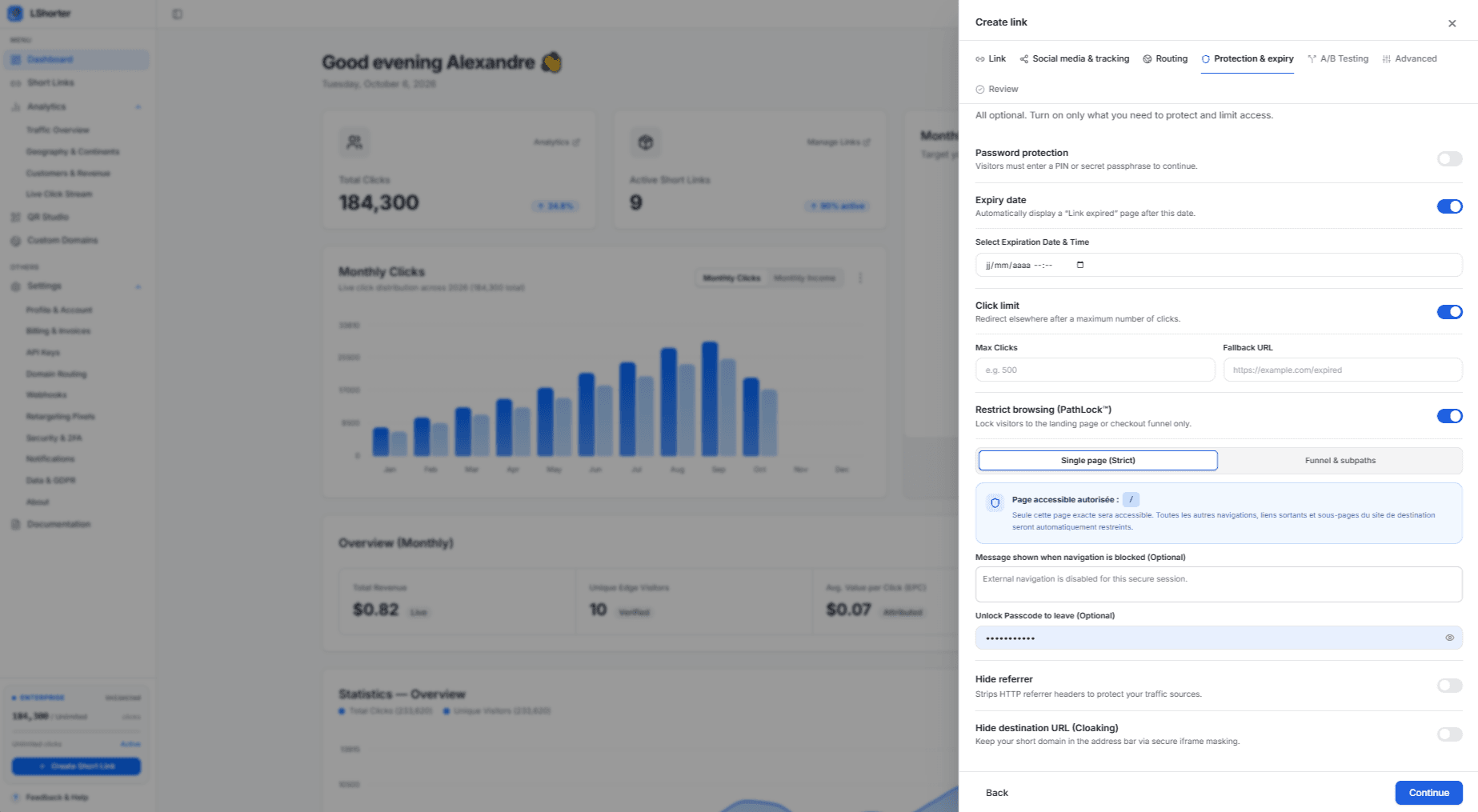
PIN code protection adds an instant zero-friction access control barrier without requiring visitors to create complex accounts or navigate heavy OAuth flows.
When a visitor opens a protected link, a lightweight, secure edge interface prompts them for the 4-digit PIN. Upon validation, an ephemeral session token is granted and redirection executes immediately.
Core architectural pillars ensuring high performance, isolation, and security.
Ready-to-use TypeScript code snippets and configuration examples for your integrations.
Specify the pinCode property when creating the link:
Direct HTTP request methods, parameters schema, authentication, and responses.
Enables, updates, or disables PIN code protection on a specific short link.
| Parameter | Type | Required | Description | Example |
|---|---|---|---|---|
| id | string | Required | Short link ID or slug alias. | finance-q3 |
| Parameter | Type | Required | Description | Example |
|---|---|---|---|---|
| pinCode | string | null | Required | 4-digit PIN code string, or null to disable protection. | 8492 |
| maxAttempts | number | Optional | Maximum failed attempts allowed before temporary IP block.Default: 5 | 5 |
The isProtected field confirms the security state without exposing the raw code:
Expert tips to maximize performance, resilience, and link security.
Avoid trivial PINs like 0000 or 1234 for sensitive financial documents or client proposals.
Distribute the PIN code through an out-of-band communication channel (e.g. SMS / WhatsApp for PIN, Email for short link).
Pair PIN protection with an expiration date (expiresAt) for defense-in-depth confidentiality.